More built-up than Seattle?
We recently took a look at Seattle’s zoning evolution to see how it compares to proposals to add infill in Anchorage. The TLDR: Anchorage’s MMHOP proposal would make low-density neighborhoods even more built up than similar neighborhoods in Seattle, without adding more housing units.
Some background: in 2023, WA passed HB 1110, effectively ending singe-family home zoning throughout the state. In Seattle, this required allowing at least 4 units per lot on all residential lots, and up to 6 units per lot near frequent transit stops or if at least two units are preserved as affordable housing. In 2025, Seattle updated it’s own comprehensive plan to formalize compliance with the state law. In addition to the increased density, the city focused on Neighborhood and Urban Centers, while streamlining design and review processes. It also took a position on additional forward-thinking elements like including a requirement for parking spots dedicated to EV charging, and front setbacks that encourage porches instead of building up to the sidewalk and that leave space for future street and sidewalk scapes.
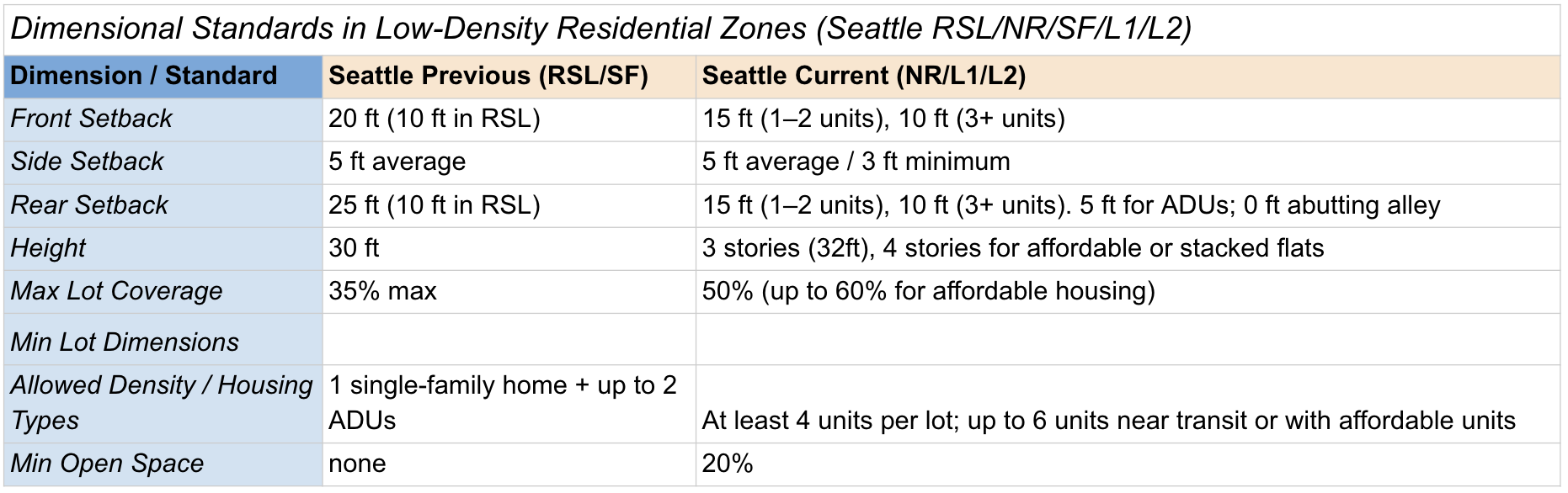
The thing we were most curious about in Seattle however was how lot dimensions changed with the new laws. The City of Seattle’s Zoning Compliance Report covers new setbacks, height, lot coverage, open space and density allowances. See the chart below for how those dimensions changed. The summary of the changes is basically “more homes on a similar footprint” with minor setbacks and height changes. The most significant change is to lot coverage, which increased from 30% to 50%. It also included a protection for green space and tree canopies by adding a requirement for 20% open space (up from none).
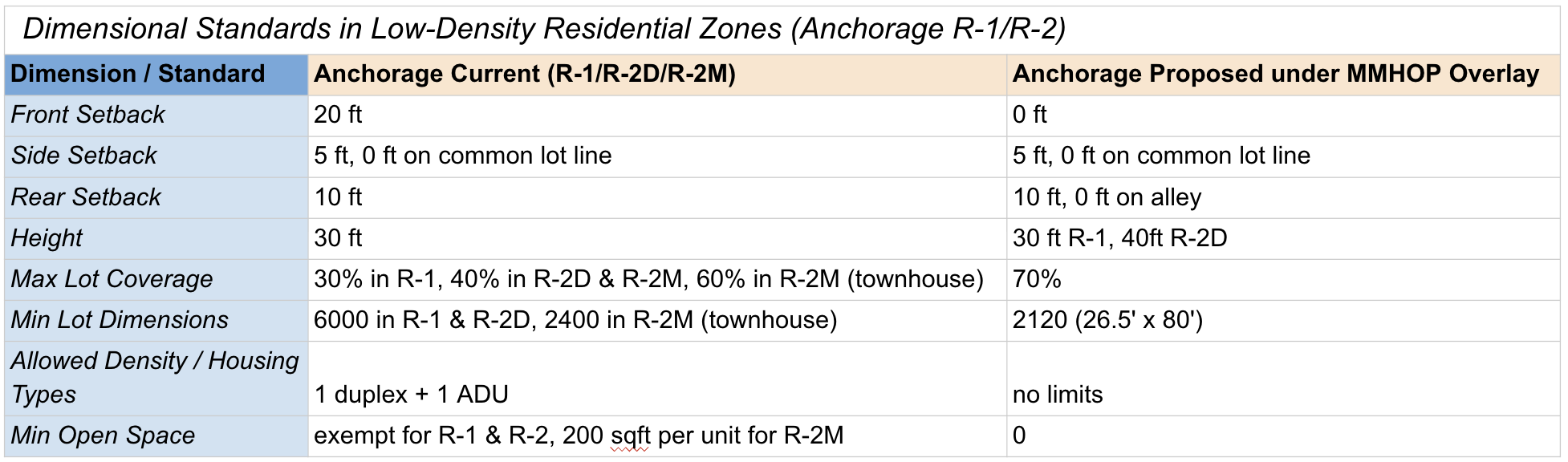
How does this compare to Anchorage? We’ve covered what’s included in MMHOP previously (see past post for more details), but in short, it’s far more liberal (or “drastic”, depending on how you see it). Where Seattle new buildings are limited to 50% lot coverage, Anchorage builders can go all the way to 70%. Front setbacks are gone under MMHOP (aside from any utility or ROW easements), basically removing room for future street scapes. And then there’s height; even Seattle, a taller denser city than Anchorage, decided that 32 feet is plenty in neighborhoods–no need to allow luxury homes with heights of 40 feet to fill in around short single-family homes.
Speaking of luxury homes, Seattle also closed a glaring loophole that MMHOP sponsors seem to have missed; by adding FAR (Floor Area Ratio) limits and capping heights, builders can’t use the added lot coverage allowances to just build larger single family homes. Without FAR limits (or other unit minimum provisions), we fully expect that what Anchorage will see is single-family renovations and new builds with larger footprints and higher price points. Whoops.